Screen Production Research in New Zealand
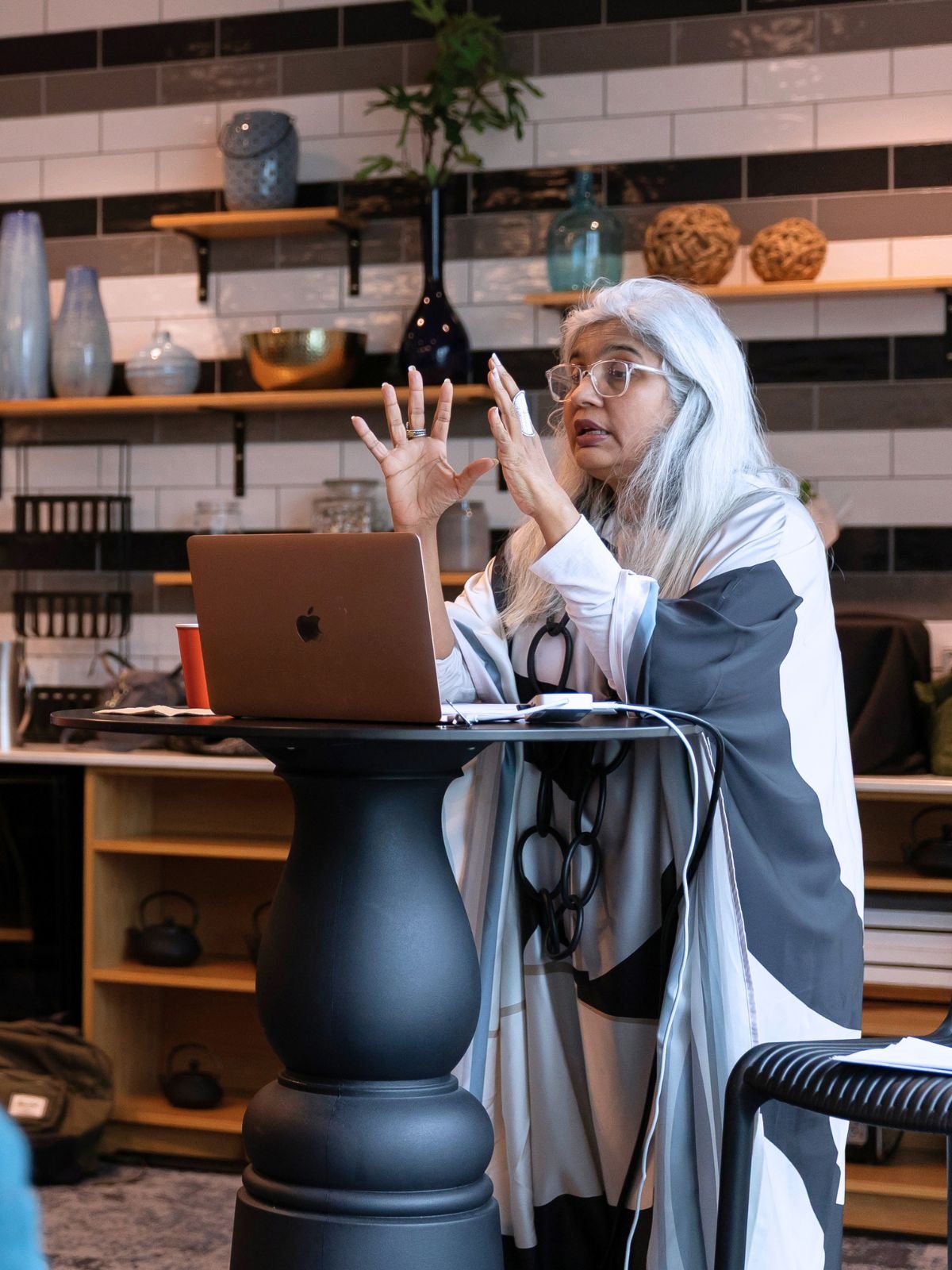
Shuchi Kothari’s academic and creative practice research brings together screenplay studies, production studies and issues of representation, equity, diversity and inclusion. Shuchi is currently working with Sarina Pearson on a Royal Society of New Zealand’s Marsden funded project that examines the history of Asian screen production in Aotearoa New Zealand from the 1980s to the present. Part of this project is the creation of www.asianzonscreen.co.nz, a living archive chronicling New Zealand’s pan-Asian filmmakers and their productions.
Shuchi’s expertise in storytelling led to collaborate on five transdisciplinary projects (funded by HRC and MBE) with the University of Auckland’s School of Nursing. Applying Kaupapa Māori principles to digital storytelling for equity in public health policy and practice, including Māori participants co-creating first-person videos narrating end-of-life care experiences, preserves knowledge, strengthens wellbeing and honours lived experience, particularly of wāhine Māori.
In film, television and community media, Shuchi treats screen production as both a creative and ethical practice — one that relies on listening deeply and engaging with difficult truths.
She also publishes in the field of creative practice research and praxis.
Selected publications & research outputs
Chapters in books
GOLBAKSH, G, S KOTHARI “Pan-Asian Storytelling for Aotearoa New Zealand Screens” in Rose Ferrell and Rosanne Welch edited Shaping Global Cultures through Screenwriting: Women Who Write Our Worlds, Intellect Books Bristol, UK 2025
KOTHARI, S.T “Ensemble Films” In Deborah Wardle, Julienne van Loon et al (eds.), A to Z of Creative Writing Bloomsbury Publishing ISBN 9781350184237, 2022
KOTHARI, S.T. and ZALIPOUR, A. “Shuchi Kothari” in A. Zalipour (ed) Migrant and Diasporic Film and Filmmaking in New Zealand. Singapore: Springer 2019 145-158
WILLIAMS, L., GOTT, M., MOEKE-MAXWELL, T., BLACK, S, KOTHARI, S, PEARSON,S., SIMPSON, P., MORGAN, T., GRBIN, M., WHAREMATE, R., HANSEN, W. “Death, dying and digital stories” in P. Beresford and S. Carr (eds.) Social Policy First Hand. Bristol: University of Bristol Press 2018
KOTHARI, S.T (Re)Making Murphy: The Development of a Transcultural Animated Feature Screenplay. In S. B. Carmen, & M. McVeigh (eds.), Transcultural Screenwriting: Telling Stories for a Global World, New Castle upon Tyne: Cambridge Scholars Publishing, 154-171, 2017
KOTHARI, S.T and DAS, N.J.“Grappling with Multiple Languages in Cinema: The Case of Firaaq” In Rita Kothari and Rupert Snell (eds.) Chutneyfying English: The Phenomenon of Hinglish , New Delhi: Penguin Books India, 185-190, 2011
KOTHARI, S.T and PEARSON, SR, “Producing Media: The project, the producer, the vision and the budget.” In Luke Goode and Nabeel Zuberi (eds.) Media Studies in Aotearoa/ New Zealand. Auckland: Pearson, 1-11, 2010.
KOTHARI, RA. and KOTHARI, S.T., “Crossing the Border in Opposite Directions: Two Partition Narratives.” In Anjali Gera Roy and Nandi Bhatia (eds.), Partitioned Lives: Narratives of Home, Displacement and Resettlement, Delhi: Pearson Longman, 146-156, 2007.
KOTHARI, S.T “Questioning the Audience.” In Luke Goode and Nabeel Zuberi (eds.), Media Studies in Aotearoa/New Zealand, Auckland: Pearson, 46-58, 2004.
KOTHARI, S.T, PEARSON, SR., ZUBERI, NM. “Multiculturalism and Television in Aotearoa/New Zealand.” In Roger Horrocks and Nick Perry (eds.), Television in New Zealand: Programming the Nation, Melbourne: Oxford University Press, 135-151, 2004.
KOTHARI, S.T and ZUBERI, NM. “The Heart is still Indian: Bollywood and the South Asian Diaspora.” In Alexandra Schneider and Cecilia Hausheer (eds.), Alpine Reflections on an Indian Silver Screen, Zurich, Museum Für Gestaltung, 162-169, 2002
Articles in refereed journals
Dizon, L., Williams, L., Moeke-Maxwell, T., Pearson, S., KOTHARI, S., & Simpson, P. (2025). “Using film and intergenerational colearning to enhance knowledge and attitudes toward older adults.” Journal of Intergenerational Relationships.
PEARSON S.R and KOTHARI S.T, Digital Storytelling in the Pacific and “Ethnographic Orientalism”. 10.2307/j.ctv2tsxjdk.10.
S. KOTHARI, "A Rebel With a Cause: Haseena Moin and Urdu Drama Serials", in BioScope: South Asian Screen Studies Sage Publication, DOI: 10.1177/0974927619896773, March 2020
Williams L., Gott, M. Moeke-Maxwell, T. Black, S. KOTHARI, S. Pearson, S., . . . Hansen, W. W. (2017). Can digital stories go where palliative care research has never gone before? A descriptive qualitative study exploring the application of an emerging public health research method in an indigenous palliative care context. BMC palliative care, 16(1), 46
PEARSON, S.R. and KOTHARI, S.T., “Menus for a Multicultural New Zealand”, Continuum: Journal of Media and Cultural Studies, 21.1 (2007): 45-58.
KOTHARI, S.T., “From Genre To Zenana: Urdu Drama serials and Women's culture in Pakistan”, Contemporary South Asia, 14.3 (2005): 289-305.
KOTHARI, S.T. and KOTHARI R.A., “Roots and Routes: Two Partition Narratives” Indian Journal of World Literature and Culture, 1.1(2004): 95-100.
Shorter Publications
KOTHARI, S.T. “Screen Diversity” The Woman Writers’ Handbook (ed Ann Sandham) Published September 2020, Aurora Metro Books ISBN 1912430339 pag 63-67
KOTHARI, S.T. and PEARSON, S.R. “Taste of Place: Stories of Food and Loss.” In Michael Hanne (ed) Creativity in Exile, Amsterdam: Rodopi, 227-228, 2004.
KOTHARI, S.T. “Such a Long Journey by Rohinton Mistry, film by Sturla Gunnarsson.” In Jaina C Sanga (ed), South Asian Literature in English: An Encyclopedia, Westport, Connecticut: Greenwood Press, 313-315, 2004.
KOTHARI, S.T. “Upamanyu Chatterjee.” In Jaina C Sanga (ed), South Asian Literature in English: An Encyclopedia, Westport, Connecticut: Greenwood Press, 44-46, 2004.
For a full list of publications, conference papers and creative outputs, please visit Shuchi Kothari’s profile on the University of Auckland website.